Yuyang Ma

Yuyang (Johnny) Ma

Ph.D. Student @ USC | Industrial & Systems Engineering

Yuyang Ma is a Ph.D. student in the Daniel J. Epstein Department of Industrial and Systems Engineering at University of Southern California. He received a master's degree in operations research from Georgia Institute of Technology in 2022. Prior to that, he received a bachelor's degree in industrial engineering from the University of Pittsburgh (Pittsburgh, United States) and a bachelor's degree in industrial engineering from Sichuan University (Chengdu, China). Yuyang's research interests lie in optimization under uncertainty and corresponding applications. He is currently working with Dr. Karmel S. Shehadeh.


News

Nov 2025

Our paper "Integrated Planning of Drone-Based Disaster Relief: Facility Location, Inventory Prepositioning, and Fleet Operations under Uncertainty" can be now accessed on SSRN 🥳.

Aug 2025

I am now continuing my Ph.D. journey at University of Southern California.

Dec 2022

I am honored to obtain Master's degree from Georgia Tech.

Selected Works

Integrated Planning of Drone-Based Disaster Relief: Facility Location, Inventory Prepositioning, and Fleet Operations under Uncertainty

Submitted

Yuyang Ma, Karmel S. Shehadeh, Man-Yiu Tsang

PDF SSRN

Teaching


Georgia Institute of Technology

Contact

The best way to contact is through e-mail (yuyangm 'at' usc 'dot' edu). Please indicate the purpose of the e-mail in the subject line, and I will try to respond as soon as possible. Besides, you can also reach me through the following ways:

Office Address

3650 McClintock Ave, Room 304
Los Angeles, CA 90089

Visitor Map

Download PDF

Miscellaneous Moments

When I am not solving optimization problems, I enjoy exploring nature, photography, and spending time with my cats.

Xiaobao 2024

Submitted

Integrated Planning of Drone-Based Disaster Relief: Facility Location, Inventory Prepositioning, and Fleet Operations under Uncertainty

Authors: Yuyang Ma, Karmel S. Shehadeh, Man-Yiu Tsang Status: Under Review

Motivation

When earthquakes and hurricanes strike, roads collapse and communities become isolated overnight—yet those first hours are when aid matters most. From Japan's Noto Peninsula earthquake to Hurricane Dorian in the Bahamas, destroyed infrastructure has left survivors without food, water, or medical care for days. Drones offer a lifeline: they fly over rubble and flooded highways to deliver critical supplies directly to those in need. But planning drone relief is far from simple—decisions about facility placement, inventory, fleet size, and drone assignments are deeply coupled and must be made under profound uncertainty about disaster outcomes.

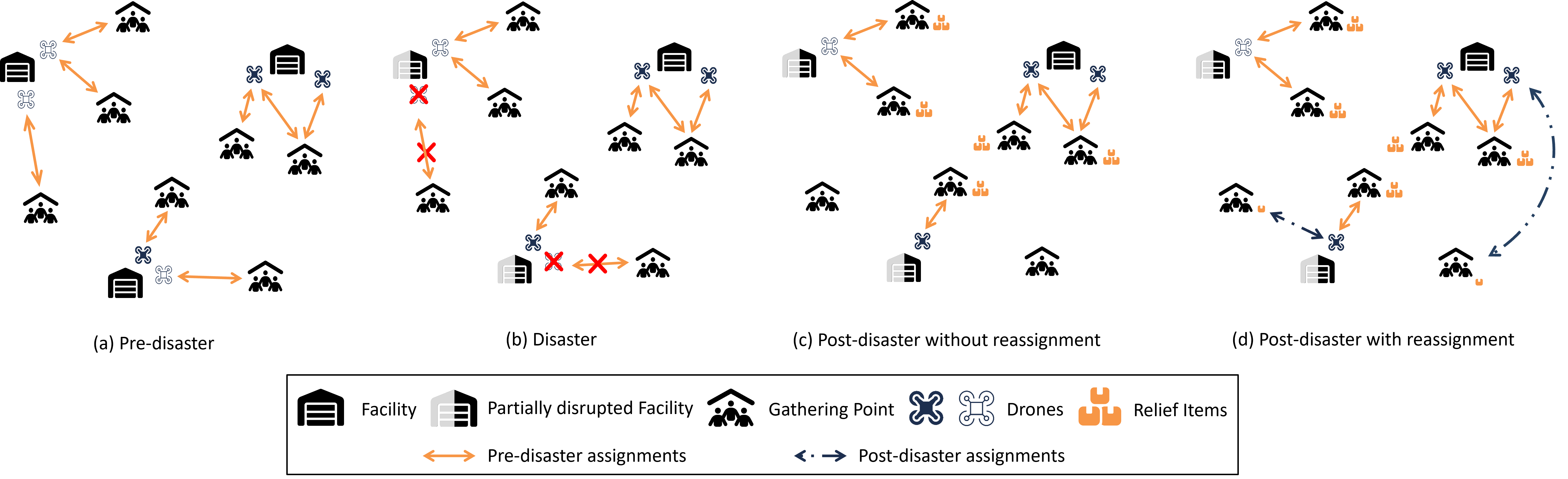
Illustration of drone-based disaster relief operations showing four phases: pre-disaster planning, disaster disruption, post-disaster without reassignment, and post-disaster with reassignment
Drone-based disaster relief: (a) pre-disaster planning, (b) disaster disruption, (c) post-disaster without reassignment, and (d) post-disaster with reassignment.

What We Do

We introduce a two-stage robust optimization framework that tackles all of these decisions simultaneously. Before the disaster, the model determines where to build relief facilities, what to stockpile, how many drones to deploy, and where to assign them. After the disaster, it adaptively distributes supplies and—crucially—reassigns surviving drones to the areas that need them most. A key innovation is our decision-dependent uncertainty set, which captures, for the first time, that a drone's post-disaster functionality depends on which facility it was assigned to before the disaster.

Why It Matters

Existing models fix drone assignments before the disaster and never revisit them—if a drone is destroyed, its assigned communities go without aid. Our model breaks this rigidity through post-disaster drone reassignment. In two real-world case studies (the 2013 Lushan and 2008 Wenchuan earthquakes in China), plans without reassignment lead to over 130% higher unmet demand. With our approach, drones held in reserve at intact facilities are dynamically redeployed to cover the gaps—turning potential shortages into delivered aid.

Key Contributions

  • An integrated robust optimization model for facility location, inventory prepositioning, fleet sizing, and drone assignment under decision-dependent uncertainty
  • A novel post-disaster drone reassignment mechanism that provides decision-makers with contingency plans, dramatically reducing unmet demand
  • A K-adaptability approximation solved via a tailored column-and-constraint generation algorithm
  • Validation on two real-world earthquake case studies demonstrating substantial operational benefits